E-mail: info@gem-cablesolution.com
 Address: No.8 Yuefeng Rd, High Tech Zone, Dongtai, Jiangsu, China | No.109 Qilin East Rd, Daning, Humen, Dongguan, Guangdong, China.
 English
  English
 русский
 日本語
日本語 Español
 عربى
عربى 中文简体
中文简体



Content
A fish tape is like a "super pathfinder" in an electrician's hands. When you need to run electrical wires through long walls, conduits, or ceilings, you can't simply push the flexible wires through. That's where this tool comes in handy.
Although its name includes the word "fish," it has nothing to do with fishing; the working principle is just somewhat similar.
1. What exactly is a fish tape?
It's usually a thin, hard, and very flexible steel or fiberglass strip, stored in a circular plastic reel.
Head: The front end of the steel strip usually has a small hook or loop to attach the electrical wire.
Characteristics: It's hard enough to push forward without bending, yet flexible enough to navigate around bends in the conduit.
Connection: The electrical wires we need to run through are actually finished products manufactured by a wire and cable extruder. The fish tape's job is to ensure these brand-new cables are successfully installed.
2. How to use it?
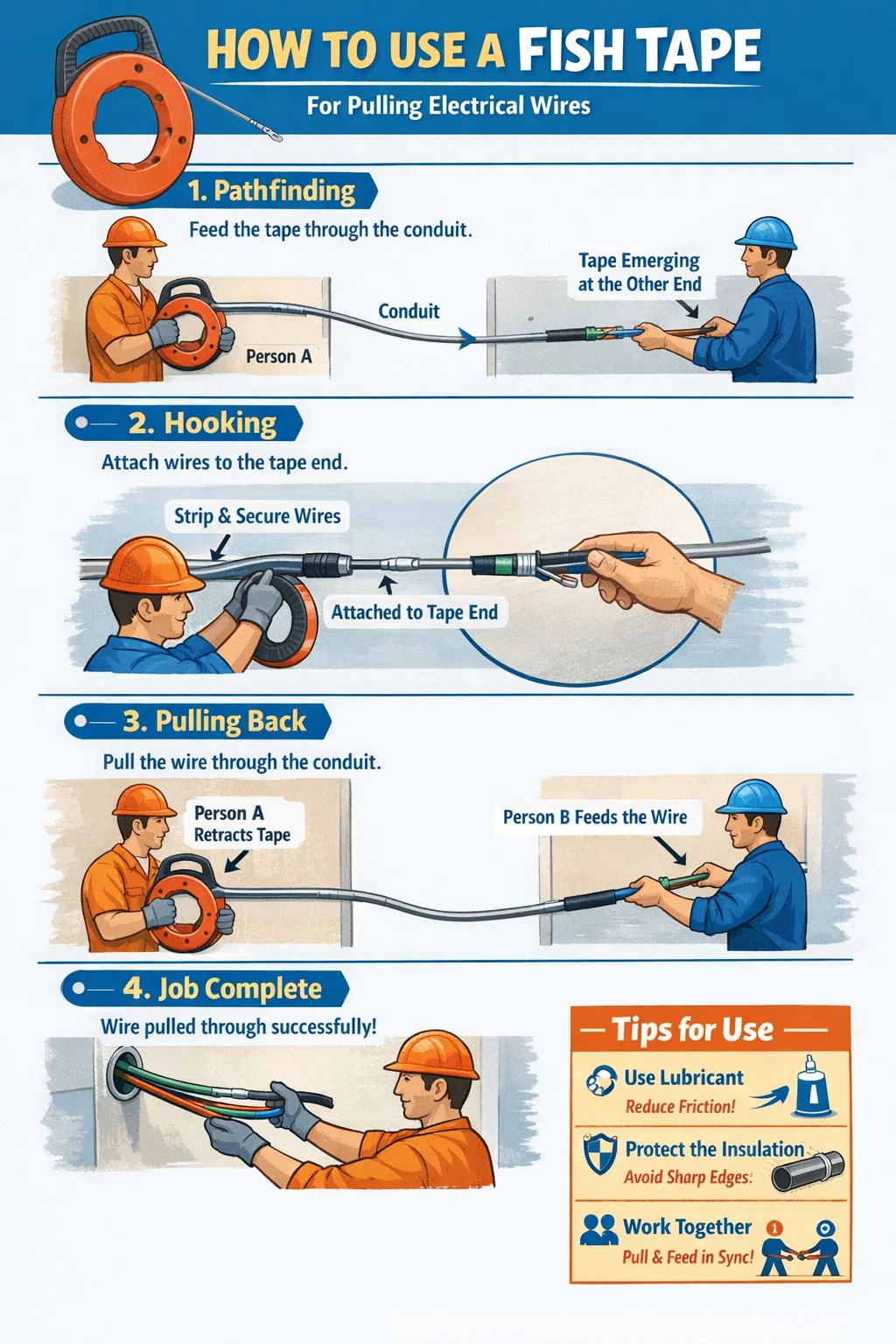
Using a fish tape usually requires two people working together. The process involves the following simple steps:
Step 1:
Pathfinding (Feeding the tape) One person stands at one end of the conduit and slowly rotates the reel, pushing the steel tape into the conduit until the head of the tape emerges from the other end.
Step 2:
Hooking (Attaching the wire) The person at the other end receives the tape and strips a small section of the wire (the smooth wires processed by the wire and cable extruder), securely wrapping it around the small loop at the end of the steel tape. For added security, a few turns of electrical tape are usually wrapped around the connection to make it smoother.
Step 3:
Pulling back (Retrieving the tape) The person who fed the tape starts rotating the reel in reverse, pulling the steel tape back. At this point, the person at the other end is responsible for "feeding the wire," ensuring that the wires don't get tangled or stuck.
Step 4:
Job complete When the wire emerges from the conduit opening, the connection can be released, and the excess steel tape can be wound back into the reel.
3. Tips for Use
Apply some lubricant: If the conduit is particularly long or has many bends, making it difficult to pull the wires through, you can apply a special wire-pulling lubricant to the wires. This reduces friction and prevents the wire insulation from being damaged during pulling.
Protect the wire insulation: Remember that although the protective layer extruded by the wire and cable extruder is durable, you should avoid forcefully pulling the wires through sharp conduit openings.
Two-person cooperation: One person pulls while the other pushes. This coordinated effort prevents the steel tape from breaking or the wires from getting stuck.
 Related Products