E-mail: info@gem-cablesolution.com
 Address: No.8 Yuefeng Rd, High Tech Zone, Dongtai, Jiangsu, China | No.109 Qilin East Rd, Daning, Humen, Dongguan, Guangdong, China.
 English
 English
 русский
 日本語
 Español
 عربى
 中文简体




Content
- 1 What XLPE Material Is and What It Gives You
- 2 Three Routes to Crosslink XLPE Material, and What Each Does to Your Floor
- 3 What XLPE Material Demands From Your Extrusion Line
- 4 XLPE in Sheaths, Jackets and Halogen-Free Designs
- 5 After Insulation: Cabling, Taping and the Tension Question
- 6 Defects You Will See When Running XLPE, and What They Usually Mean
- 7 Quality Checks That Catch XLPE Problems Before Shipping
- 8 Material Handling, Storage and Changeover Discipline
- 9 Choosing Between XLPE and Its Close Relatives
- 10 Frequently Asked Questions About XLPE Material
- 10.1 What does XLPE stand for and what is it made of?
- 10.2 Does XLPE melt at high temperature?
- 10.3 Can XLPE be run on an extruder set up for PVC?
- 10.4 How do you know whether XLPE is fully cured?
- 10.5 What insulation thickness does a 4 sq mm XLPE core need?
- 10.6 Does XLPE contain halogens or produce toxic smoke?
- 10.7 Why does XLPE cost more than PVC insulation?
- 10.8 What is the most common cause of XLPE cable failure in production?
A 4 sq mm XLPE insulated core comes off the line with a 0.72 mm wall against a 0.80 mm nominal, and the hot-set sample stretches to 190 percent before it breaks. The compound supplier gets the phone call, but most of the time the material is fine and the line is not. The melt sat too long in the head, the die was centred 0.15 mm off, and the cooling trough pulled the core straight before the molecular network had a chance to form properly.
Here is the short version first, because it explains everything that follows: XLPE material is polyethylene whose molecular chains have been joined into a three-dimensional network, so it behaves like a thermoset both on the extrusion line and in service. It will not melt and flow again once cured. That single fact decides how cold the barrel must run, how short the residence time must be, how the cure step is designed, and why an under-cured drum cannot simply be re-run through the machine.
This guide walks through what XLPE actually is, how the three crosslinking routes differ on a real production floor, which screw and temperature settings keep output inside tolerance, the defect patterns that point to a machine problem rather than a compound problem, and how to choose between XLPE and the materials that sit next to it in a cable catalogue.
What XLPE Material Is and What It Gives You
XLPE starts as ordinary polyethylene, usually a low-density or linear low-density base resin, sometimes blended with a higher-density grade for stiffness or with fillers for flame performance. In that uncrosslinked state it is a thermoplastic. Heat it and it flows, which is exactly what allows it to be extruded over a conductor at 120 to 190 degrees Celsius without any chemical change taking place.
Crosslinking changes that permanently. Whether the links are created by peroxide, by grafted silane plus moisture, or by an electron beam, neighbouring chains bond into a network. From that point the material keeps its shape under heat. It will char and eventually degrade, but it will not soften and drip the way PVC does when a joint overheats.
The practical payoffs are measurable. Continuous conductor temperature rating climbs from 70 degrees Celsius for PVC to 90 degrees Celsius, emergency overload capability reaches roughly 130 degrees Celsius for limited periods, and short-circuit conductor temperatures of up to 250 degrees Celsius are permitted for durations measured in seconds, as set out in IEC 60502-2 for extruded insulation power cables. Relative permittivity sits near 2.3 and dissipation factor typically stays below 0.0005 at power frequency, an order of magnitude better than plasticised PVC. For the same conductor size, an XLPE insulated design usually carries 15 to 25 percent more current than its PVC equivalent at the same conductor limit.
The trade-offs are just as real. The base polymer is halogen free and burns without producing corrosive acid gases, but that also means it has no inherent flame resistance, so flame-retardant grades load in mineral fillers such as aluminium trihydrate or magnesium dihydroxide at 50 to 60 percent by weight. That loading changes everything about how the compound extrudes. Moisture also matters: in wet alternating-current service, older XLPE designs have shown water treeing, which is one reason modern compounds use tree-retardant formulations and why semiconductive screens matter so much.
| Property | XLPE | PVC | Thermoplastic PE |
|---|---|---|---|
| Structure | Crosslinked network, thermoset | Thermoplastic | Thermoplastic |
| Continuous conductor temperature | 90 C | 70 C | 70 to 80 C |
| Relative permittivity at power frequency | About 2.3 | 5 to 8 | About 2.3 |
| Dissipation factor | Below 0.0005 | 0.02 to 0.05 | Below 0.0005 |
| Halogen content of base polymer | None | Contains chlorine | None |
| Curing step required | Yes | No | No |
| Typical use | Medium voltage power, solar DC, EV high voltage | Building wire, flexible cords | Coax, telecom, low voltage jacketing |
Three Routes to Crosslink XLPE Material, and What Each Does to Your Floor
Peroxide (dry cure) crosslinking
Dicumyl peroxide is compounded into the resin at roughly 1.5 to 2.5 parts per hundred. The extruder itself runs cold because the peroxide begins decomposing above about 140 degrees Celsius, so melt temperature at the die is held below roughly 130 degrees Celsius. The actual cure happens downstream in a pressurised tube, usually with nitrogen at 10 to 18 bar, where wall temperatures step through a profile that can reach into the 250 to 400 degrees Celsius range depending on tube design. Methane and other by-products remain in the insulation, so the cable is then degassed in an oven at 60 to 80 degrees Celsius for 24 to 72 hours. Skip or shorten degassing and partial discharge readings on medium voltage cable will drift from drum to drum. This route gives the best dielectric performance and handles thick walls, which is why most 6 kV to 500 kV cables are made this way.
Silane moisture crosslinking
A silane-grafted compound is extruded together with a catalyst masterbatch at ordinary thermoplastic temperatures of about 150 to 190 degrees Celsius, then cured by moisture. Cure happens in a warm water bath at 70 to 90 degrees Celsius for several hours, or at ambient conditions over days. Because moisture has to diffuse into the wall, cure time scales roughly with the square of thickness. Below about 3 mm wall this works well; above roughly 5 mm it becomes impractical. Capital cost is far lower than a continuous vulcanisation line, which is why silane XLPE dominates low voltage cores up to 1 kV and appears in some 10 kV designs.
Electron beam crosslinking
An electron beam at 1 to 3 MeV delivers a dose of roughly 100 to 300 kGy and crosslinks the polymer in seconds without heat or peroxide. There is no curing tube and no degassing, so the process is clean and fast, but electrons only penetrate so far, which limits wall thickness to roughly 1 mm. It suits automotive wire, appliance cable, heat-shrink tubing and thin-wall control cores. The equipment cost is high and the geometry constraints are strict.
What XLPE Material Demands From Your Extrusion Line
Anyone who has spent years running PVC will find XLPE unfamiliar in three ways: the barrel runs cooler, the residence time matters more, and the die geometry has to be matched to the compound. Knowing the parts that make up an extruder helps here, because the fix for most XLPE problems sits in the screw, the head or the cooling section rather than in the compound bag.
Screw geometry
For unfilled peroxide XLPE, a length-to-diameter ratio of 20:1 to 25:1 with a compression ratio of 2.5 to 3.5 is the usual starting point. Heavily filled halogen-free flame-retardant crosslinkable compounds prefer a gentler compression ratio of 1.8 to 2.5, deeper flights and more torque headroom, because the filler raises viscosity sharply. A mixing or barrier section pays for itself: unmelted resin particles that pass through the die become gel specks visible in the finished insulation and are almost impossible to remove later. The feed throat should be water cooled to below 40 degrees Celsius to prevent bridging and premature softening.
Temperature profile that avoids scorch
The table below shows a workable starting profile for a 65 mm, 24:1 single screw machine running a peroxide-cured XLPE insulation on a small power core. It is a starting point, not a recipe: the correct numbers depend on compound grade, screw design and output rate, and every change should be verified with a hot-set sample before a full drum is released.
| Parameter | Indicative value | Why it matters |
|---|---|---|
| Feed zone | 85 to 100 C | Feeds without bridging, keeps peroxide dormant |
| Compression zones | 105 to 120 C | Complete melting without local hot spots |
| Head and die | 115 to 125 C | Controls surface finish and memory of the die |
| Melt temperature at die exit | Below 130 C | Above this, scorch risk rises fast |
| Drawdown ratio | 1.5 to 3.0 | Balances die swell against internal stress |
| Output on 65 mm machine | 120 to 200 kg/h | Keeps residence time short |
| Line speed, small cores | 100 to 250 m/min | Must be matched to cure capability |
Wall thickness, eccentricity and tolerances
Nominal insulation thickness for a 4 sq mm core in a 0.6/1 kV design sits around 0.7 mm, while a 6/10 kV cable per IEC 60502-2 carries roughly 3.4 mm of XLPE over the conductor screen. The commonly applied acceptance rule is that the minimum measured wall must not fall below 90 percent of nominal minus 0.1 mm. Eccentricity, expressed as maximum wall minus minimum wall divided by maximum wall plus minimum wall, times 100, should be held at or below 8 percent for low voltage, 5 percent for medium voltage and 3 percent for the higher voltage classes. In practice that means centring the crosshead in 0.05 mm steps and confirming with an in-line X-ray or optical gauge, not once at the start of a shift but on every drum. Good quality wire insulation extrusion machines give you the fine mechanical adjustment needed to hold those numbers repeatably.
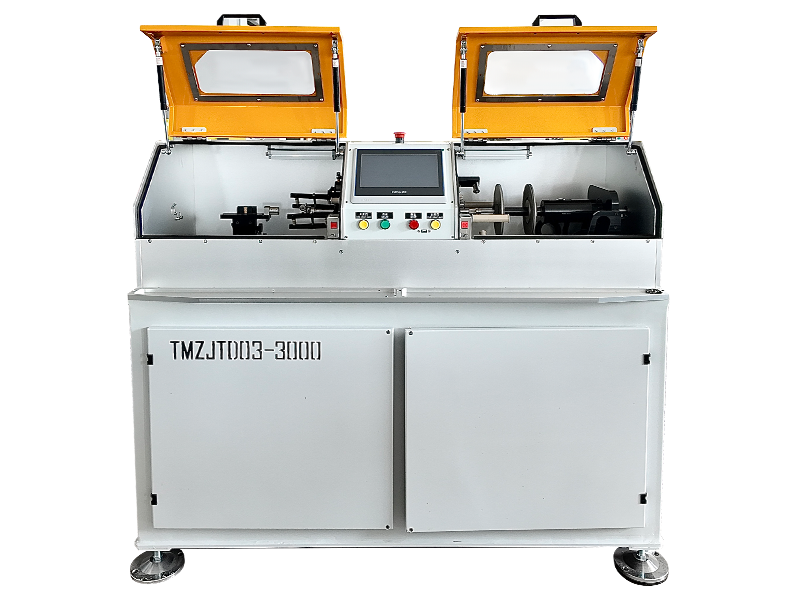
 LSZH/XLPE/TPE/TPU Core Wire Insulation Extrusion LineLSZH/XLPE/TPE/TPU Core Wire Insulation Extrusion Line is an non-standardized equipment with customization. The main machine model is generally 30-65mm. It is suitable ...View Product →
XLPE in Sheaths, Jackets and Halogen-Free Designs
The outer sheath of an XLPE insulated cable is rarely peroxide XLPE. It is more often PVC, thermoplastic PE, a low smoke zero halogen compound, or a crosslinkable halogen-free polyolefin that offers the same heat resistance without the dielectric demands of an insulation layer. The extrusion behaviour is different enough that it deserves its own settings. A sheath compound loaded with 50 to 60 percent mineral filler needs a lower compression ratio, deeper channels, slower screw speed and a wider die gap, and melt temperature should usually stay between 160 and 185 degrees Celsius to avoid decomposing the filler, which releases water vapour and creates porosity in the jacket.
Wall thickness tolerances on a jacket are looser than on insulation, typically minus 15 percent of nominal with no lower limit below 80 percent of nominal, but surface quality and ovality matter for cable pulling and jointing. Where the design calls for a crosslinked halogen-free jacket rather than a thermoplastic one, the same cure logic described earlier applies, which means the extruder, the curing section and the take-up all have to be sized together rather than retrofitted piece by piece.
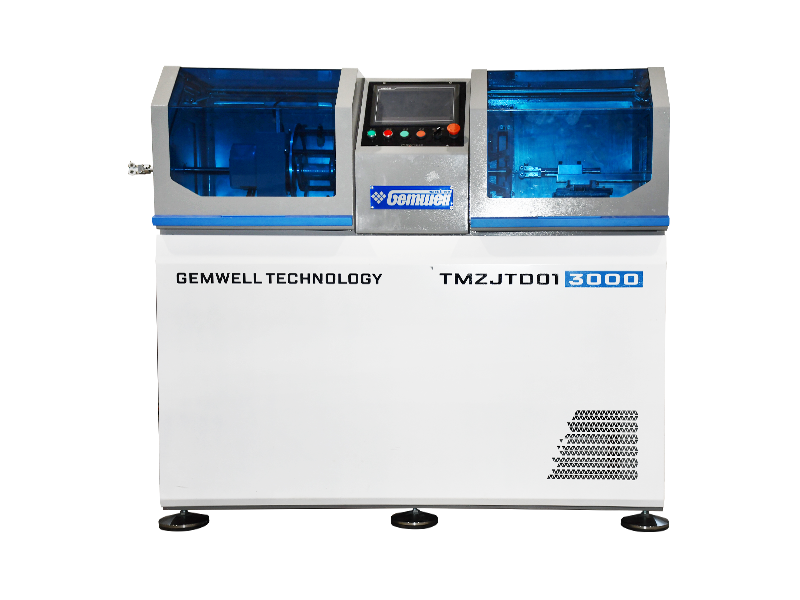
LSZH/XLPE/TPE/TPU Sheath Extrusion LineLSZH/XLPE/TPE/TPU Sheath Extrusion Line is a non-standardized equipment with customization. The main machine model is generally 70-150mm. It is mostly used in the prod...View Product →After Insulation: Cabling, Taping and the Tension Question
An XLPE insulated core is not finished when it leaves the cooling trough. Fire-resistant designs get a mica tape wrap directly over the core, medium voltage constructions need metallic screening or an extruded semiconductive layer, and multi-core cables have to be assembled with fillers and binders before the jacket goes on. Every one of those steps applies mechanical load to insulation that has only just finished curing, and XLPE is unforgiving about it.
Two rules keep quality under control. First, keep take-up and pay-off tension constant within a few percent; a fluctuating tension shows up later as diameter variation and, in data cables, as impedance variation along the length. Second, control lay length precisely. A three percent drift in lay length during a long run is enough to push characteristic impedance outside a specification band on a high-frequency pair. For larger cable assemblies, a heavy-duty cantilever single twisting machine with external drawing and power take-up gives the tension stability and load capacity that a light frame simply cannot hold.
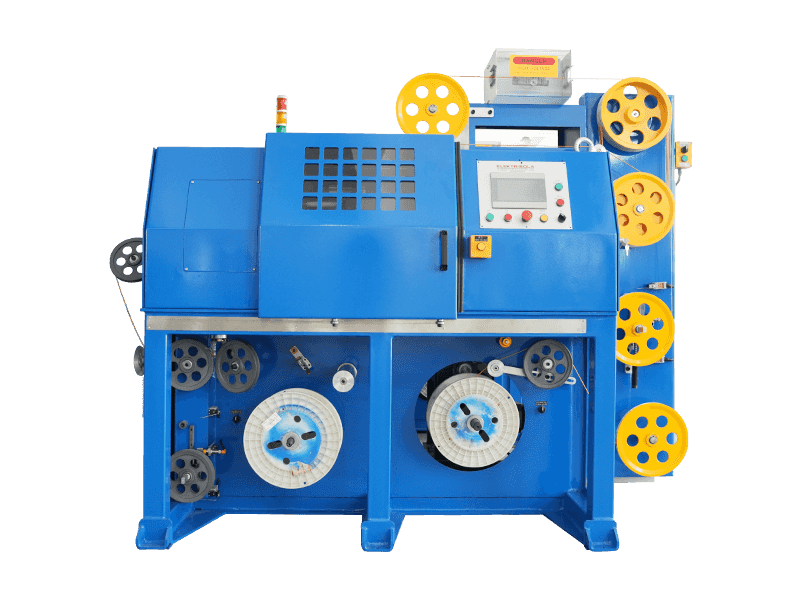
Heavy-Duty Split Type Cantilever Single Twisting Machine (External Capstan and Torque TakeThe stranding cantilever is seperated from the external capstan of the Heavy-Duty Split Type Cantilever Single Twisting Machine (External Capstan and Torque Take-Up). ...View Product →Defects You Will See When Running XLPE, and What They Usually Mean
XLPE defects are rarely random. Each one leaves a signature, and the fastest route to a fix is to read that signature before touching the compound. The table below maps the symptoms that appear most often on crosslinked polyolefin lines to the causes that produce them.
| Symptom | Most likely cause | First check |
|---|---|---|
| Scorch, hard dark deposits in the head, rising pressure | Melt temperature above the scorch threshold or long residence time | Head melt thermocouple and minimum output rate |
| Gel specks and surface pimples | Unmelted resin, hopper contamination, worn screw flights | Screen pack condition and screw wear measurement |
| Voids, bubbles or water marks | Moisture in the compound or a leaking cooling trough seal | Bag seal, vacuum hopper, trough joints |
| Eccentricity drifting out of tolerance | Crosshead off centre, worn tip, melt sag on large cores | Dial gauge centring and tip-to-die match |
| Hot-set elongation above specification | Incomplete crosslinking from low cure temperature, high line speed or low dose | Cure tube profile, line speed, bath time or beam dose |
| Poor adhesion between insulation and semiconductor screen | Temperature or shear mismatch between layers | Co-extrusion head balance and melt pressure |
| Rough surface or melt fracture | Die land too short, die temperature too low, shear rate too high | Land length, head temperature, output setting |
| Core shrinkage after cooling | Under-cure combined with excessive drawdown | Hot-set result and drawdown ratio |
Quality Checks That Catch XLPE Problems Before Shipping
A crosslinked core cannot be repaired by re-running it, so verification has to happen during production rather than at final inspection. The following sequence is standard practice on well-run lines and is worth building into the operator routine rather than the laboratory calendar.
- Dimensional check on every drum: wall thickness at three points around the circumference plus eccentricity calculation, recorded against the nominal value and the 90 percent minus 0.1 mm floor.
- Hot-set test per IEC 60811-507: a specimen loaded at 20 N per square centimetre at 200 degrees Celsius for 15 minutes should show elongation under load below 175 percent and permanent set below 15 percent. This is the single most useful cure indicator available on the shop floor.
- Gel content per ASTM D2765 for peroxide-cured compounds: solvent extraction typically returns 75 to 85 percent for a correctly cured insulation. Results below roughly 70 percent point to under-cure or a bad compound lot.
- Tensile and elongation testing before and after ageing per IEC 60811-501. Specifications commonly quote minimum values around 12.5 MPa tensile strength and 200 percent elongation at break on the aged sample, but always confirm against the applicable product standard for the cable type.
- Partial discharge testing for medium voltage and above per IEC 60885-3, with routine results usually required to stay at or below 5 pC at 1.73 times rated voltage to earth.
- Dissipation factor measurement at elevated temperature, often at 90 degrees Celsius at rated voltage, where typical acceptance limits for medium voltage XLPE cables sit around 0.004.
Material Handling, Storage and Changeover Discipline
- Peroxide-cured XLPE compound should stay in sealed foil bags until it enters the hopper. Typical shelf life is 6 to 12 months when stored below 30 degrees Celsius, and a hot warehouse shortens that considerably.
- Do not dry peroxide compound in a conventional hot air oven at 80 degrees Celsius. The peroxide starts decomposing and the granule will scorch in the barrel. If drying is genuinely necessary, use a short low-temperature vacuum cycle at 50 to 60 degrees Celsius.
- Filled halogen-free compounds are hygroscopic. Dry them at 60 to 70 degrees Celsius with a dew point below minus 20 degrees Celsius, and check the dryer as carefully as you check the extruder.
- If a peroxide XLPE run stops for more than 15 to 20 minutes, purge the barrel with a low-temperature polyethylene or drop head temperatures. Compound sitting hot and still in the head is the origin of most scorch complaints.
- Record cure parameters for every drum: line speed, cure tube temperature, bath time or beam dose, and melt temperature. Without that record, a hot-set failure three days later is almost impossible to trace back to a cause.
Choosing Between XLPE and Its Close Relatives
Peroxide XLPE wins on dielectric strength and heat resistance, which is why it owns the medium and high voltage world. Silane XLPE wins on capital cost and simplicity, which is why it owns most low voltage cores. Electron beam XLPE wins on speed and cleanliness for thin walls. Crosslinkable halogen-free polyolefin compounds win where flame performance and low smoke matter more than dielectric loss, such as in tunnels, rolling stock and public buildings.
Ethylene propylene rubber remains the alternative where extreme flexibility is required, for example in welding cable and portable power leads, because it stays flexible at low temperature and tolerates repeated bending better than XLPE. It costs more and gives up some dielectric performance. The selection rule is straightforward: if the cable will be flexed constantly, look at rubber; if it will be installed and left alone for decades, XLPE usually delivers more ampacity per unit of copper and per unit of insulation cost.
Frequently Asked Questions About XLPE Material
What does XLPE stand for and what is it made of?
XLPE stands for crosslinked polyethylene. It is made from polyethylene resin, usually low density or linear low density, combined with a crosslinking system. That system is either an organic peroxide such as dicumyl peroxide, a grafted silane with a catalyst, or nothing at all when an electron beam supplies the energy. Additives for antioxidant protection, tree resistance and flame retardance are added depending on the application.
Does XLPE melt at high temperature?
No. Once crosslinked, XLPE is a thermoset. It does not have a melting point in the way polyethylene does. Heat it far enough and it degrades and chars, but it keeps its form below that point. This is why an XLPE cable can be rated for 90 degrees Celsius continuously and 250 degrees Celsius for a few seconds under short-circuit current.
Can XLPE be run on an extruder set up for PVC?
Physically it will extrude, but the settings will damage the compound. PVC typically runs with barrel temperatures of 160 to 190 degrees Celsius, and peroxide XLPE must stay below roughly 130 degrees Celsius at the die to avoid scorch. Using PVC temperatures usually produces hard deposits in the head within half an hour, along with rising pressure and surface defects.
How do you know whether XLPE is fully cured?
The hot-set test is the fastest practical answer. Per IEC 60811-507, a specimen held at 200 degrees Celsius under a load of 20 N per square centimetre for 15 minutes should show elongation under load below 175 percent and permanent set below 15 percent. Gel content testing per ASTM D2765 gives a second, more fundamental confirmation, typically returning 75 to 85 percent for a well cured peroxide compound.
What insulation thickness does a 4 sq mm XLPE core need?
For a 0.6/1 kV cable per IEC 60502-1, the nominal insulation thickness on a 4 sq mm core is about 0.7 mm. The acceptance rule normally applied is that no measured point may fall below 90 percent of nominal minus 0.1 mm, which for this size means roughly 0.53 mm as an absolute floor.
Does XLPE contain halogens or produce toxic smoke?
The base polymer contains no halogens, so it does not release hydrogen chloride the way PVC does. That said, "halogen free" and "low smoke" are not the same claim. Flame-retardant crosslinkable polyolefin compounds are formulated with mineral fillers to suppress smoke and limit heat release, and those formulations behave quite differently in the extruder.
Why does XLPE cost more than PVC insulation?
Two reasons. The compound itself costs several times more per kilogram than plasticised PVC. On top of that, it requires a curing step, which for peroxide grades means a continuous vulcanisation line and a degassing oven. The offset is performance: higher ampacity, higher temperature rating and better dielectric behaviour, which often allow a smaller conductor or a thinner wall for the same job.
What is the most common cause of XLPE cable failure in production?
In production it is under-cure, followed closely by contamination. Under-cure traces back to line speed running ahead of the cure capability, a cure profile that drifted, or a silane bath that was too cool or too short. Contamination comes from hoppers, worn screws, damaged screens and airborne dust around the feed area, and it shows up as gels and surface defects rather than as a measurable electrical change.
XLPE material rewards discipline more than it rewards clever settings. Get the melt temperature right, keep residence time short, size the cure step honestly against the line speed, and verify cure with a hot-set sample rather than with a hunch. Everything else, from eccentricity to surface finish to shrinkage, follows from those four habits.
When results drift, separate the variables in order: compound lot, then line settings, then the machine itself. In most plants the answer arrives faster that way, and an under-cured drum never has to become a customer complaint.
 Related Products