E-mail: info@gem-cablesolution.com
 Address: No.8 Yuefeng Rd, High Tech Zone, Dongtai, Jiangsu, China | No.109 Qilin East Rd, Daning, Humen, Dongguan, Guangdong, China.
 English
  English
 русский
 日本語
日本語 Español
 عربى
عربى 中文简体
中文简体




Foreword
In recent years, global data transmission demand has exploded, leading to rapid iteration and upgrades of high-speed interconnect solutions. DAC passive copper cables, with their low cost, low latency, and excellent performance, have become the mainstream solution for short-distance transmission; however, limited by physical transmission characteristics, their effective distance continues to shorten as bandwidth increases, highlighting increasingly prominent bottlenecks.
To address the challenges of high bandwidth and long distances, the industry has successively launched upgraded solutions such as AOC active optical cables, ACC active copper cables, and AEC active copper cables. Among them, AEC active copper cables, by integrating a Retimer chip to achieve signal clock recovery and complete reconstruction, significantly compensate for high-frequency attenuation, extend transmission distance, and reduce link jitter, becoming the core technology direction for next-generation high-speed copper cables, with broad market prospects. Although AEC represents the future trend, DAC still dominates the current market due to its cost and maturity advantages, resulting in increasingly fierce industry competition.
In the high-speed copper cable industry chain, bare wire manufacturing processes and complete sets of equipment are the core links determining product consistency, electrical performance, and yield. Gemwell, a professional manufacturer of complete high-speed copper cable equipment, has deep expertise in the field of high-frequency and high-speed cable equipment, providing stable and reliable manufacturing solutions for high-end cables such as DAC/ACC/AEC.
At the High-Frequency and High-Speed Technology Seminar to be held in Wuxi, Jiangsu on April 22, 2026, Gemwell's engineering team will showcase multiple mature customer application cases, focusing on pain points in high-speed cable manufacturing processes, equipment selection, and process optimization. They will engage in in-depth exchanges with industry peers and explore pathways for technological upgrades. We cordially invite you to attend and discuss cooperation!
In recent years, global data transmission demand has exploded, leading to rapid iteration and upgrades of high-speed interconnect solutions. DAC passive copper cables, with their low cost, low latency, and excellent performance, have become the mainstream solution for short-distance transmission; however, limited by physical transmission characteristics, their effective distance continues to shorten as bandwidth increases, highlighting increasingly prominent bottlenecks.
To address the challenges of high bandwidth and long distances, the industry has successively launched upgraded solutions such as AOC active optical cables, ACC active copper cables, and AEC active copper cables. Active copper cables with integrated retimer chips achieve signal clock recovery and complete reconstruction, significantly compensating for high-frequency attenuation, extending transmission distance, and reducing link jitter. This makes them a core technology direction for next-generation high-speed copper cables, with a promising market prospect. Although AEC represents the future trend, DACs still dominate the current market due to their cost and maturity advantages, leading to fierce industry competition.
In the high-speed copper cable industry chain, bare wire manufacturing processes and complete sets of equipment are the core links determining product consistency, electrical performance, and yield. Gemwell, as a professional manufacturer of complete high-speed copper cable equipment, has deep expertise in the field of high-frequency and high-speed cable equipment, providing stable and reliable manufacturing solutions for high-end cables such as DAC/ACC/AEC.
At the high-frequency and high-speed technology seminar held in Wuxi, Jiangsu on April 22, 2026, Gemwell's engineering team will showcase multiple mature customer application cases, focusing on high-speed cable manufacturing pain points, equipment selection, and process optimization. They will engage in in-depth exchanges with industry peers and explore technology upgrade paths. We cordially invite you to attend and discuss cooperation!
Professionals Do Professional Work
The technology of wires and cables is advancing rapidly. Gemwell focuses on the equipment matching and R&D of industry-leading technologies and is happy to share its expertise and win-win philosophy within the wire and cable industry.
The consistent quality of high-speed transmission line production depends on the precision of core process equipment, the level of online control and monitoring, and operational stability. The three key processes of core wire insulation extrusion, parallel pair wrapping, and parallel pair cabling directly determine the uniformity of the wire structure and the stability of its electrical performance. Fluctuations in dielectric structure and properties will directly cause characteristic impedance shift, impedance mismatch, increased signal reflection, and attenuation degradation, ultimately leading to signal distortion. Therefore, strictly controlling the structural uniformity and process stability of each process is the core of ensuring product quality.
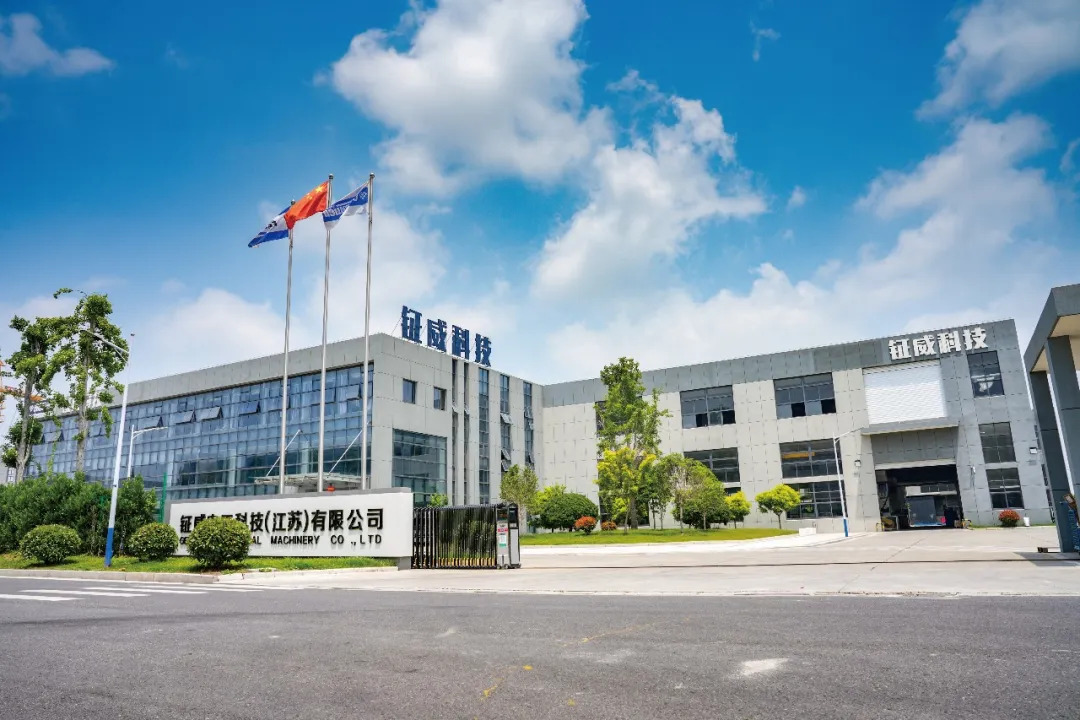
For high-quality transmission lines, choose Gemwell.
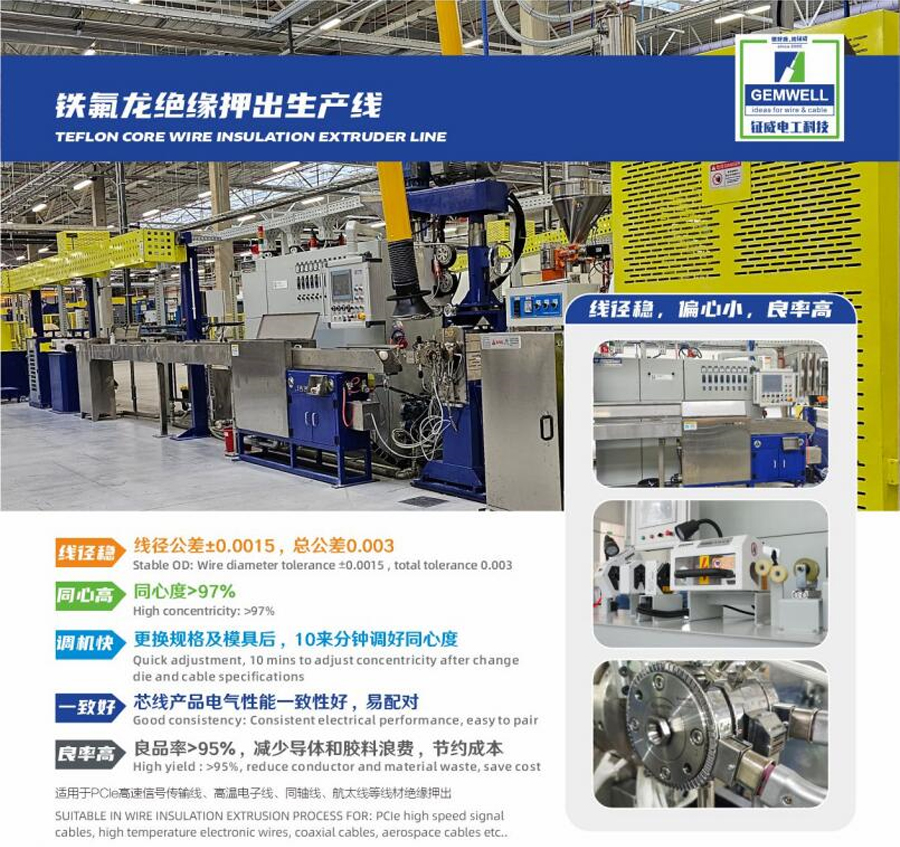
01 Extrusion
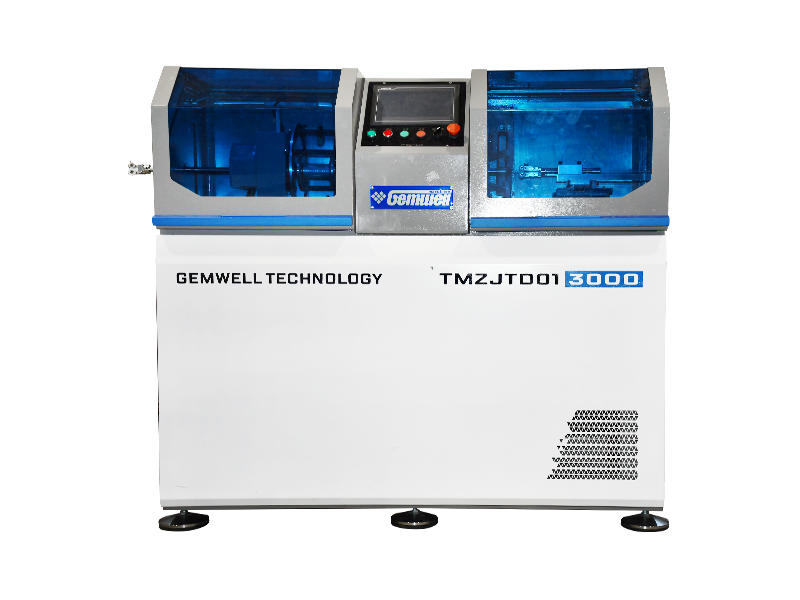
The core wire insulation extrusion process requires strict control over key indicators such as conductor tension, pitch, ellipticity, surface cleanliness, insulation concentricity, outer diameter tolerance, underwater capacitance tolerance, and extrusion temperature tolerance. The equipment should have online closed-loop control for outer diameter/concentricity, online underwater capacitance detection, precise temperature control, and closed-loop tension adjustment. It should also be equipped with a CPK process capability index analysis module to quantitatively assess extrusion stability and process capability, ensuring consistent electrical performance of high-speed transmission lines from the source.
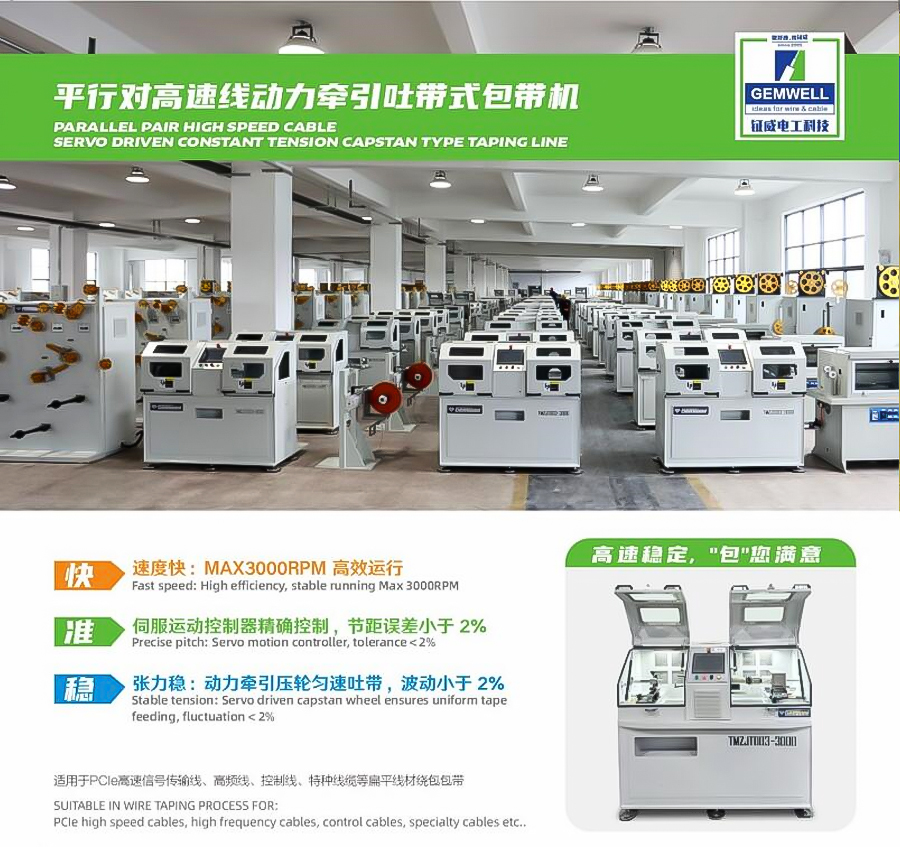
Parallel pair wrapping and cabling equipment must have constant tension control, precise pitch synchronization, wrapping overlap rate, online symmetry monitoring, and abnormal alarm functions to ensure stable pair structure and further suppress impedance fluctuations and signal loss.
02. TAPING
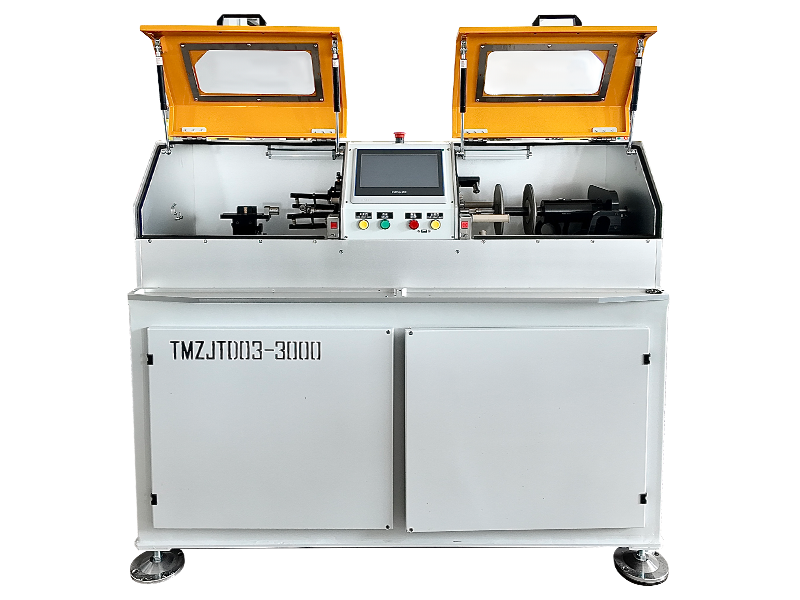
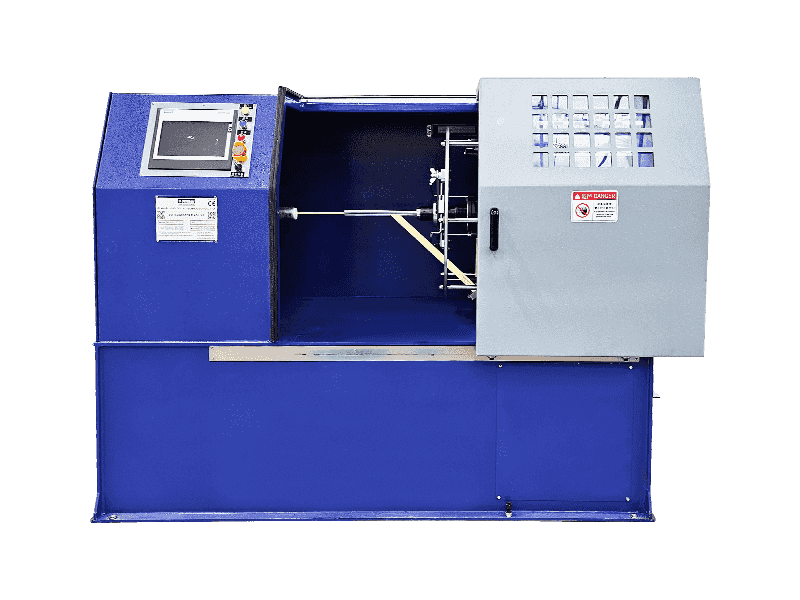
The parallel pair wrapping process is a core step in ensuring the structural stability and shielding performance of high-speed transmission lines. To prevent problems such as deformation during subsequent cabling, loose wrapping, ground wire displacement, and shielding failure, it is crucial to control two key aspects: wrapping stability and heat fusion reliability.
The wrapping process must ensure uniform pitch and constant tension to avoid uneven dielectric structure degrading transmission performance. The aluminum foil thickness and overlap rate must be strictly controlled: for ordinary cables, an overlap rate of 15–25% is sufficient, but the parallel pair structure itself has no anti-crosstalk capability. To meet near-end crosstalk attenuation requirements, the aluminum foil overlap rate must be controlled at 30–60%.
The heat fusion process requires adding self-adhesive polyester tape over the metal shielding layer to achieve the final shape of the pair structure. The hot-melt temperature of the self-adhesive tape must be controlled below 200℃: Excessive temperature can cause the insulated core wires to soften and stick together, leading to deterioration of high-frequency performance; insufficient temperature will result in incomplete melting of the hot-melt adhesive, weak adhesion, and potential for missed adhesion. This can lead to loosening of the wrapping, opening of the aluminum foil, and electromagnetic wave leakage during later use, causing shielding failure and product scrapping. After parallel wires exit the oven, they must be rapidly cooled and cured to prevent residual heat from causing core wire sticking and ground wire misalignment/reversal, ensuring long-term stability of structural dimensions and electrical performance.
03 Cabling
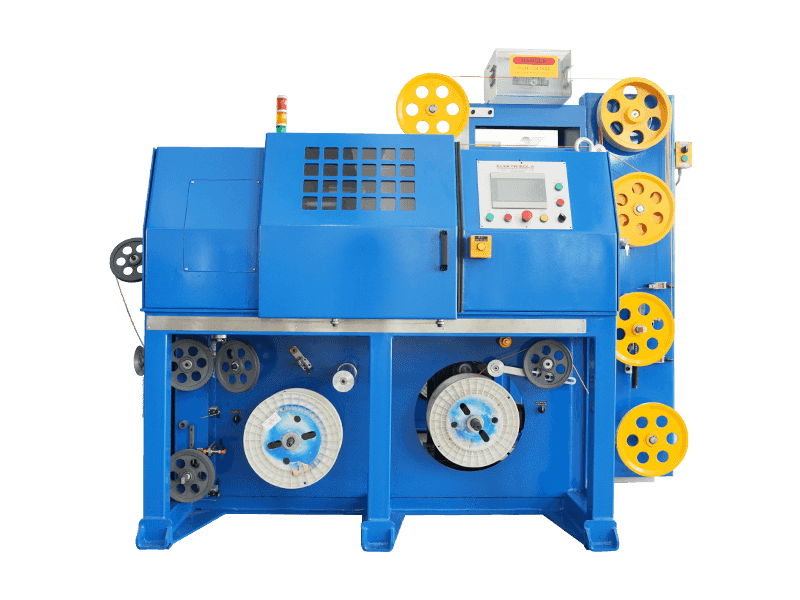
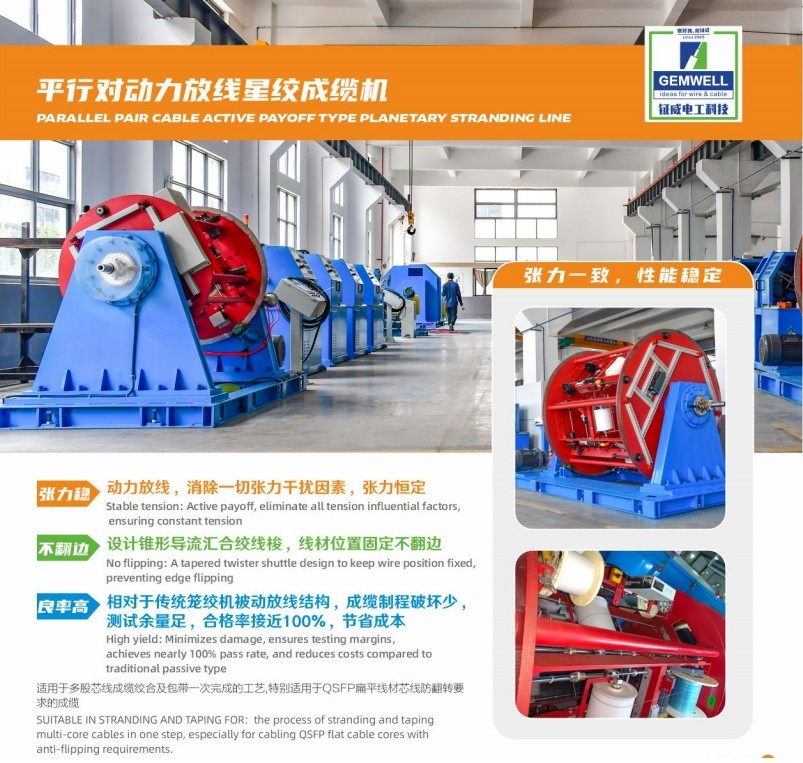
The cabling process for composite stranded wire involves grouping and stranding qualified parallel pairs while simultaneously wrapping them with polyester tape and aluminum foil tape. This achieves structural shaping and overall shielding, directly determining the final comprehensive electrical performance of the cable. During production, strict control over the structural consistency and stranding uniformity of each pair is required, along with online monitoring of key electrical properties such as impedance, time delay difference, and attenuation to avoid the problem of excellent performance in previous processes but deteriorated performance after cabling.
Addressing the industry-wide pain point of unstable performance after cabling, Gemwell's power-feeding star stranding machine uses a servo motor for independent power feeding, ensuring highly consistent tension in each parallel pair and effectively suppressing stranding deformation and impedance fluctuations. Long-term verification by multiple mainstream wire manufacturers shows a near 100% yield rate, significantly improving production efficiency and reducing manufacturing costs.

 Related Products