E-mail: info@gem-cablesolution.com
 Address: No.8 Yuefeng Rd, High Tech Zone, Dongtai, Jiangsu, China | No.109 Qilin East Rd, Daning, Humen, Dongguan, Guangdong, China.
 English
  English
 русский
 日本語
日本語 Español
 عربى
عربى 中文简体
中文简体



Content
- 1 The Global Wire and Cable Industry: Size and Scale
- 2 Regional Breakdown: Which Markets Dominate
- 3 Segment-by-Segment Breakdown of the Wire and Cable Market
- 4 What Is Driving Growth in the Wire and Cable Industry
- 5 The Wire and Cable Extruder Market Within the Broader Industry
- 6 Raw Material Supply: Copper, Aluminum, and Polymer Compounds
- 7 Capacity Constraints and the Investment Cycle in Cable Manufacturing
- 8 Employment and Economic Impact of the Wire and Cable Industry
- 9 Technology Trends Reshaping Wire and Cable Manufacturing
The Global Wire and Cable Industry: Size and Scale
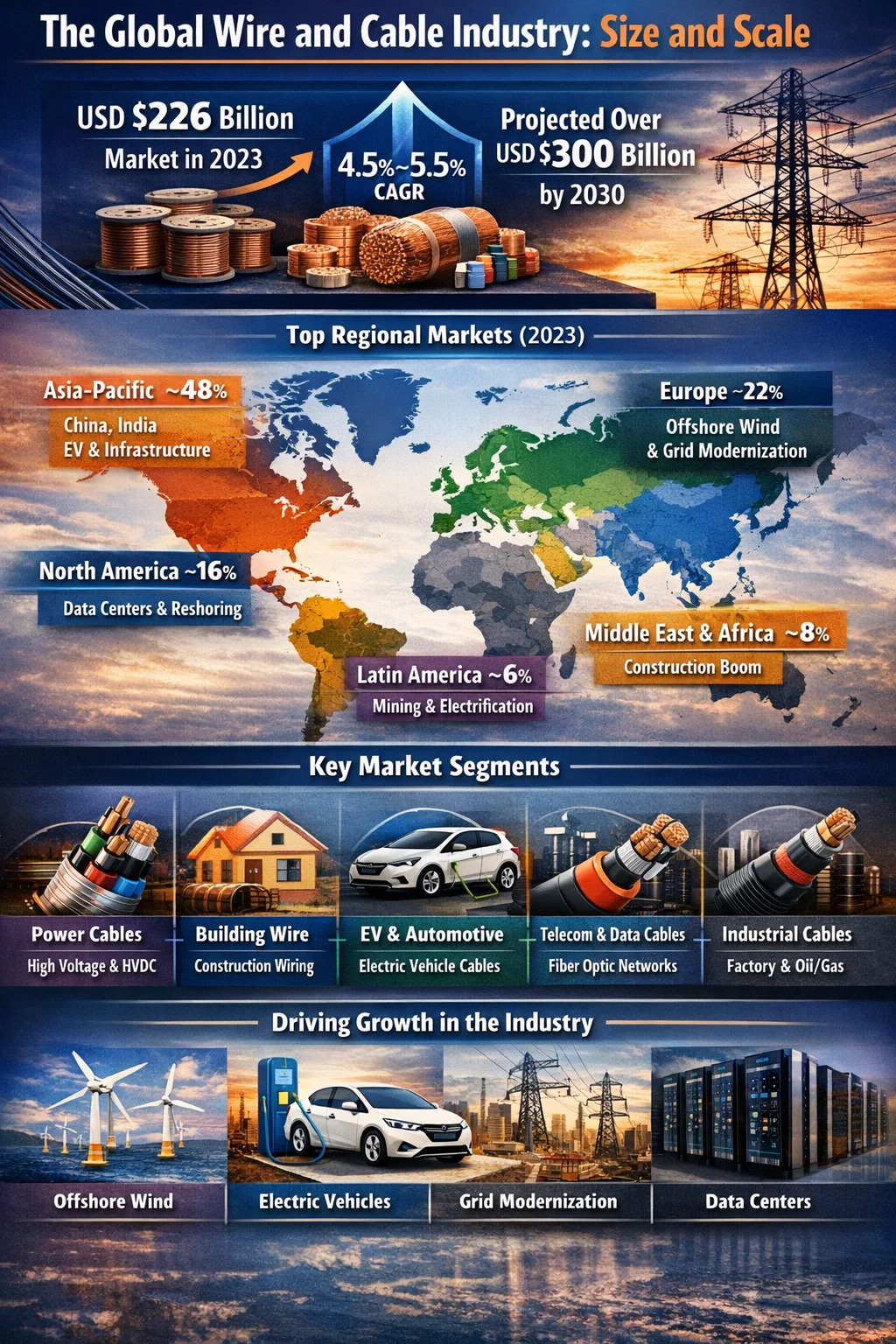
The wire and cable industry is one of the largest manufacturing sectors in the world. The global wire and cable market was valued at approximately USD 226 billion in 2023, and analysts project it will surpass USD 300 billion by 2030, growing at a compound annual growth rate (CAGR) of around 4.5% to 5.5% depending on the segment. This scale makes the industry comparable in revenue to the global semiconductor equipment sector and significantly larger than many other well-known manufacturing industries.
To put that in physical terms, the industry produces hundreds of millions of kilometers of wire and cable annually. A single large-scale wire and cable extruder line running at 1,000 meters per minute on a small-gauge product can produce over 500,000 kilometers of insulated wire in a single year. The sheer volume of material processed — copper, aluminum, PVC, XLPE, PE, LSZH compounds — is staggering. Copper consumption alone by the wire and cable industry represents roughly 60% to 65% of total global refined copper demand, which in 2023 amounted to approximately 15 million metric tons out of a global total of around 25 million metric tons.
Regional Breakdown: Which Markets Dominate
The wire and cable industry is not evenly distributed globally. Production and consumption are heavily concentrated in a small number of regions, with Asia-Pacific leading by a wide margin.
| Region | Estimated Market Share (2023) | Key Growth Driver | Projected CAGR (2024–2030) |
|---|---|---|---|
| Asia-Pacific | ~48% | China infrastructure, India urbanization, EV manufacturing | 5.5% – 6.5% |
| Europe | ~22% | Offshore wind, grid modernization, EV adoption | 4.0% – 5.0% |
| North America | ~16% | Grid investment, data centers, reshoring of manufacturing | 4.0% – 4.8% |
| Middle East & Africa | ~8% | Construction boom, power infrastructure expansion | 5.0% – 6.0% |
| Latin America | ~6% | Electrification projects, mining industry cables | 3.5% – 4.5% |
China alone accounts for roughly 35% of global wire and cable production, driven by its massive power grid expansion program, real estate and infrastructure construction, and its position as the world's largest EV market. Chinese wire and cable manufacturers — led by companies like Hengtong Group, Zhongtian Technology, and Baosheng Science and Technology — have scaled rapidly and now compete globally, including for submarine cable projects in Southeast Asia and Africa.
In Europe, the market is defined by high-specification products for offshore wind, high-voltage direct current (HVDC) transmission, and fire-safe building cables under the EU Construction Products Regulation. European cable makers such as Prysmian (Italy), Nexans (France), and NKT (Denmark/Germany) have invested heavily in capacity for submarine cables and are running wire and cable extruder lines capable of producing cables at voltages up to 525kV HVDC.
Segment-by-Segment Breakdown of the Wire and Cable Market
The wire and cable industry is not a single homogeneous market. It is divided into several distinct segments, each with its own dynamics, technology requirements, and growth rates. Understanding these segments is essential for anyone evaluating where demand for wire and cable extruder equipment is heading.
Power Cables (Transmission and Distribution)
This is the largest single segment, accounting for roughly 35% to 40% of the total wire and cable market by value. Power cables carry electricity from generation sources to end consumers through transmission networks (operating at 66kV to 500kV and above) and distribution networks (typically 1kV to 33kV). The global push to replace aging overhead lines with underground cables, connect offshore wind farms, and expand HVDC links between countries is sustaining strong demand. Prysmian's order backlog for high-voltage and submarine cables exceeded EUR 15 billion in recent years, illustrating how far ahead demand is running relative to installed production capacity.
Building Wire and Wiring Systems
Building wire — the PVC or XLPE-insulated conductors used in residential and commercial construction — is the highest-volume segment by the total length of cable produced. This segment is tightly linked to construction activity. In the United States, the building wire market alone exceeds USD 10 billion annually. Products like THHN/THWN (rated to 90°C in wet locations), NM-B (Romex), and armored cable (MC cable) are produced on high-speed single-screw wire and cable extruder lines that can run at speeds above 500 meters per minute.
Automotive and EV Wire
The automotive wire segment is growing faster than almost any other. Traditional automotive wire — thin-wall PVC or XLPE-insulated copper conductors bundled into wiring harnesses — is being augmented by high-voltage cables for battery electric vehicles. These HV cables operate at 400V to 800V DC, require specialized shielding and insulation systems, and must meet demanding thermal and mechanical performance standards. The global automotive wire harness market was valued at over USD 50 billion in 2023, and a significant portion of that growth traces directly back to increased wire content per vehicle driven by electrification.
Telecom and Data Cables
This segment includes fiber optic cables, structured cabling (Cat 6, Cat 6A, Cat 8 for data centers), coaxial cables, and LAN cables. Global fiber optic cable deployment has been accelerating sharply, driven by FTTH (fiber to the home) programs in Asia and Europe, and by hyperscale data center construction worldwide. The US Broadband Equity, Access, and Deployment (BEAD) program alone committed USD 42.5 billion for broadband expansion, a significant portion of which funds fiber cable deployment. Wire and cable extruder lines for fiber optic secondary coating and buffer tube production must achieve extremely tight dimensional tolerances — typically ±0.005mm — at line speeds up to 300 meters per minute.
Industrial and Instrumentation Cables
Industrial cables for factories, oil and gas platforms, mining operations, and process plants represent a highly specialized and high-value segment. These cables include tray cables, instrumentation cables, thermocouple extension cables, variable frequency drive (VFD) cables, and explosion-proof cables for hazardous locations. Margins in this segment are considerably higher than for commodity building wire, and the wire and cable extruder configurations used here often incorporate multiple crossheads for applying shields, fillers, and outer jackets in multiple passes.
What Is Driving Growth in the Wire and Cable Industry
The industry's growth trajectory over the next decade is being shaped by several structural forces that are fundamentally different from the typical construction-cycle-driven demand of the past.
Energy Transition and Offshore Wind
The shift from fossil fuels to renewable energy is perhaps the single most powerful driver in the wire and cable industry today. Offshore wind alone requires enormous quantities of cable. A typical 1 GW offshore wind farm requires approximately 600 to 800 kilometers of inter-array cables (33kV) and 100 to 200 kilometers of export cable (132kV to 400kV). Europe currently has over 30 GW of offshore wind capacity installed and has targets exceeding 300 GW by 2050. Each gigawatt of offshore wind capacity consumes roughly 1,000 metric tons of cable insulation compound processed through specialized wire and cable extruder systems.
Electric Vehicle Penetration
EV adoption is reshaping the automotive wire segment dramatically. Beyond the vehicle itself, charging infrastructure requires significant cable investment. A single DC fast-charging station capable of 150kW to 350kW output requires thick, flexible, liquid-cooled cables that would have been considered exotic specialty products just five years ago. As global EV sales approach tens of millions of units per year, the demand for high-performance wire and cable — and the extrusion capacity to produce it — is growing at double-digit rates annually in this niche.
Global Grid Modernization
Much of the world's electrical transmission infrastructure was built in the 1960s and 1970s and is now at or beyond its design life. The International Energy Agency (IEA) estimates that global grid investment needs to reach USD 600 billion per year by 2030 to support the energy transition — more than double current annual investment levels. A substantial proportion of that investment is in cable: underground distribution cables replacing overhead lines, new transmission corridors, and cross-border interconnectors.
Data Centers and Digital Infrastructure
Hyperscale data centers being built to support AI workloads and cloud computing consume extraordinary quantities of power and signal cables. A single large data center facility can require millions of meters of structured cabling, thousands of meters of medium-voltage power cable for the incoming supply, and significant lengths of fiber optic cable for internal and external connectivity. With over 300 hyperscale data centers currently under construction globally, this segment alone is adding meaningful volume to wire and cable demand.
Urbanization in Emerging Markets
In India, Southeast Asia, Africa, and the Middle East, rapid urbanization is creating sustained baseline demand for building wire, distribution cables, and telecom cables. India's wire and cable market alone was valued at approximately USD 15 billion in 2023 and is expected to grow at over 10% CAGR through 2030, driven by the government's ambitious electrification programs, smart city initiatives, and expanding manufacturing sector. This has triggered a wave of investment in wire and cable extruder equipment by Indian manufacturers looking to expand capacity and upgrade from older machines to higher-speed, more precise modern equipment.
The Wire and Cable Extruder Market Within the Broader Industry
The wire and cable extruder market — machinery used to apply insulation and jacketing to conductors — is a significant subset of the broader wire and cable equipment market. The global wire and cable machinery market (including not just extruders but also stranding machines, armouring lines, testing equipment, and drum winders) was valued at approximately USD 4 billion to USD 5 billion annually. Of this, extrusion equipment represents the largest single equipment category.
Demand for wire and cable extruder systems closely tracks capital expenditure trends in the cable manufacturing industry. When cable demand surges — as it has since 2021 due to offshore wind, EV, and grid investment drivers — cable manufacturers respond by ordering new extrusion lines. Lead times for high-end wire and cable extruder lines from European manufacturers such as Maillefer (Nextrom), Troester, and Rosendahl have in some cases extended to 18 to 24 months due to strong order intake.
Key Wire and Cable Extruder Manufacturers and Their Focus Areas
- Maillefer (Nextrom, Finland/Switzerland): Specializes in high-voltage cable extrusion lines, fiber optic production equipment, and crosslinking systems. Their CV tube technology for XLPE insulation is widely regarded as industry-leading.
- Troester (Germany): Known for high-precision single and triple co-extrusion heads for medium- and high-voltage cables, as well as rubber cable vulcanization lines for mining and industrial applications.
- Rosendahl Nextrom (Austria): Provides complete wire and cable extrusion lines including pay-off, extruder, cooling, measuring, and take-up systems integrated with digital process control. Strong in both copper wire insulation and fiber optic secondary coating.
- Davis-Standard (USA): A leading North American supplier of wire and cable extruder systems for building wire, hookup wire, and coaxial cable applications, with a strong installed base among US and Latin American cable manufacturers.
- Chinese manufacturers (Dalian Rubber & Plastics Machinery, Zhoushan Jwell): Compete aggressively on price in the mid-tier segment, supplying wire and cable extruder machines to manufacturers in Asia, the Middle East, and Africa who need reliable performance at lower capital cost than European alternatives.
The choice of wire and cable extruder supplier often reflects the product type and quality tier targeted by the cable manufacturer. Producers of commodity building wire may opt for Chinese-built extruders to minimize capital expenditure, while manufacturers of submarine cables, automotive high-voltage cables, or aerospace wire invariably invest in European or Japanese equipment to achieve the process stability and documentation traceability required by their customers.
Raw Material Supply: Copper, Aluminum, and Polymer Compounds
The wire and cable industry is deeply dependent on the supply and pricing of key raw materials. Copper and aluminum conductor costs typically account for 50% to 70% of the total cost of a finished cable, meaning that raw material price swings have an outsized impact on industry revenues and margins.
Copper Dependency and Price Volatility
Copper is the preferred conductor material for most wire and cable applications due to its superior conductivity (around 58 MS/m versus aluminum's 37 MS/m). However, copper prices are highly volatile, ranging from around USD 6,000 per metric ton in 2020 lows to over USD 10,000 per metric ton during peak demand periods. This volatility is passed through to cable prices, making the industry's revenue figures sensitive to commodity cycles in ways that distort simple year-over-year comparisons. Many large cable manufacturers hedge copper exposure through futures contracts and maintain contracts with customers that include copper price adjustment clauses.
Polymer Compound Supply
The insulation and jacketing materials processed through wire and cable extruder systems — PVC compounds, XLPE, PE, LSZH compounds — are supplied by a global network of specialty compounders. Major suppliers include Borealis, Dow Chemical, Hanwha Solutions, and Sinopec. Supply chain disruptions, as experienced during 2020–2022, can cause significant production delays and cost increases for cable manufacturers. The growing demand for LSZH compounds, driven by tightening fire safety regulations worldwide, has pushed compounders to invest in new capacity to keep pace.
Aluminum as a Copper Substitute
In segments where weight and cost are critical — overhead transmission lines, large-cross-section distribution cables, and building wire in some markets — aluminum conductors are specified instead of copper. Aluminum is approximately one-third the cost and one-third the weight of copper per unit length (though with lower conductivity per unit cross-section). The wire and cable extruder and die head configurations used for aluminum conductors require adjustments compared to copper, as the softer aluminum surface is more susceptible to scratching and requires different crosshead preheating temperatures to achieve good adhesion of the insulation.
Capacity Constraints and the Investment Cycle in Cable Manufacturing
One of the most important dynamics shaping the wire and cable industry right now is that demand in key growth segments — particularly offshore wind cables, HVDC cables, and EV high-voltage cables — has outrun production capacity. This is not a short-term imbalance. Building a new high-voltage cable factory or significantly expanding an existing one takes three to five years from investment decision to full production, and commissioning a new wire and cable extruder line for high-voltage products is itself a 12 to 24-month process.
Prysmian, Nexans, NKT, and LS Cable have all announced major capacity expansion programs. Prysmian is investing over EUR 1 billion in new and expanded facilities through 2027 specifically for high-voltage and submarine cables. NKT is building a new factory in Germany targeting offshore wind cables. These investments include not only buildings and infrastructure but also purpose-built wire and cable extruder lines capable of triple co-extrusion of XLPE systems at voltages up to 525kV.
Order backlogs for high-voltage cables at the top manufacturers have reached four to six years in some cases, meaning cables ordered today may not be delivered until 2028 to 2030. This unprecedented situation reflects both the scale of the energy transition investment and the structural difficulty of rapidly scaling up a capital-intensive, technically demanding manufacturing process.
Employment and Economic Impact of the Wire and Cable Industry
The wire and cable industry employs hundreds of thousands of people worldwide across manufacturing, engineering, sales, installation, and support functions. In the United States alone, the wire and cable manufacturing sector employs approximately 70,000 to 80,000 people directly, with many more employed in related wire drawing, copper rod, and compound manufacturing operations. In Europe, major employers include Prysmian and Nexans, each employing more than 25,000 people globally.
The economic multiplier effect is significant. A wire and cable extruder line in production requires operators, process engineers, quality technicians, maintenance electricians and mechanics, logistics staff, and sales and customer service teams. A mid-size cable plant with 10 to 15 extrusion lines might directly employ 200 to 500 people, with additional indirect employment in local supply chains for copper rod, polymer compounds, steel wire armor, cable drums, and packaging materials.
The reshoring of wire and cable manufacturing — particularly in the United States and Europe — is becoming a policy priority as governments recognize that domestic cable production capacity is strategically important for the energy transition and national grid security. Several US cable manufacturers have announced new plant investments or expansions explicitly citing the need to supply domestic renewable energy and grid modernization projects with locally manufactured cable, reducing dependence on imports.
Technology Trends Reshaping Wire and Cable Manufacturing
Beyond raw growth in volume, the wire and cable industry is being shaped by technological changes that affect what products are made, how they are made, and what equipment is needed to make them.
Digitalization of Extrusion Lines
Modern wire and cable extruder systems are increasingly integrated with digital process control platforms. OPC-UA data connectivity, inline X-ray and laser measurement with closed-loop feedback, and MES integration allow manufacturers to track every meter of cable produced with full process traceability. This is not just a quality management benefit — it is becoming a commercial requirement, particularly for cables destined for offshore wind or nuclear applications where regulators require documented process records for the lifetime of the installation.
New Insulation Materials and Higher Voltage Requirements
The push to higher transmission voltages (to reduce resistive losses over long distances) and the development of HVDC technology are driving demand for new insulation materials and more precise extrusion processes. DC-XLPE — polyethylene formulated specifically for HVDC applications — requires ultra-clean processing conditions and extremely precise wall thickness control because DC electric fields interact with insulation defects differently than AC fields. The wire and cable extruder systems used for HVDC cable production must maintain cleanliness standards approaching those of semiconductor manufacturing in some respects.
Recycling and Circular Economy Pressures
Regulatory pressure around halogen-free and recyclable cable materials is increasing globally. The EU's Ecodesign Regulation and Extended Producer Responsibility frameworks are beginning to affect cable design and material choices. This is creating demand for new compound formulations that can be processed on existing wire and cable extruder equipment while meeting both performance standards and end-of-life recyclability requirements — a technically challenging combination that is driving significant R&D investment across the supply chain.
 Related Products